Investor OS · Private markets
One process for every deal,
from the first look to what you hold.
You can use MCP: bring your own AI process, if you have one, and it works on your deals here. Sourcing is live; the steps after it, from mandate fit to what you hold, will run in the same system.
StatusBeing finished now
Your deals and your portfolio stay yours, walled at the row level and kept in the EU.
Free, and no account: we run the diagnosis on your firm and send it to you.
How it runs today
You have tools. You do not have a system.
A form, a CRM, something that reads what arrives, a sheet for the book. Not one of them knows what the others know.
The operation
Run your whole investment process as one system.
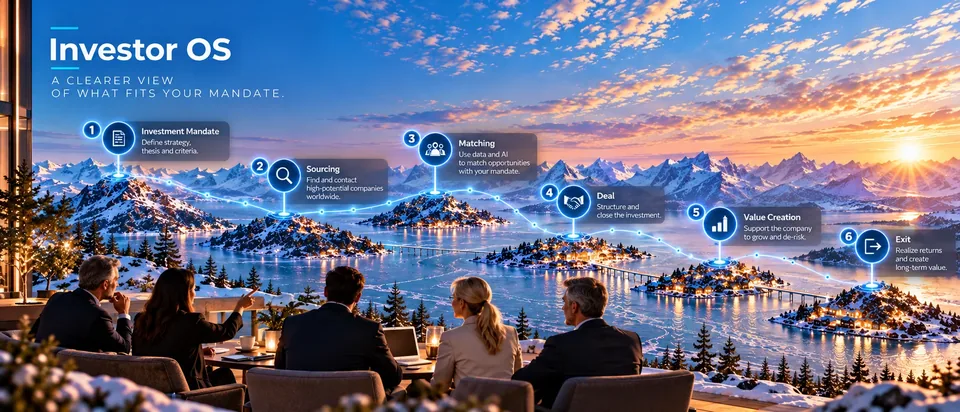
Eight steps, and each one writes what the next one reads. You decide; the system does everything either side of that.
- Sourcing and scoring — everything that arrives clears one gate. Your own inbound and your relationship graph, Market OS scanned from inside the OS, your private register if you run one: one ranked feed, one scorecard applied identically, and the case against your thesis run before you commit to liking anything.
- The decision is the pinch, and it is yours. The pre-mortem and red-team, then the IC decision itself — pre-read drafted and queued, the record signed. Two steps, deliberately narrow: everything before them prepares the judgement, everything after executes it.
- Management and exit — the book readable live. Capital deployed, then NAV, marks, reserves, intervention triggers and LP reporting across everything you hold, closing on what you passed on. And where a portfolio company runs Scale OS, your OS reads that company's development from its own record, within the consent its founder sets.
- The AI works below the judgment line. It is built to score the card against the strategy you loaded and watch the book, and switches on once AI runs in the EU. The pre-read assembles from that card, and the red-team is put in front of you to run. You approve; it executes.
And on your own business
Get smarter every turn — on your deals, and on your own raise.
The last step writes back, so the next turn starts ahead of this one — on your deals, and on the raise behind them.
Step 08 writes back. Outcomes and the anti-portfolio re-weight the mandate and the scorecard, so every turn starts from what the last one learned. Run without the write-back, the same loop decays.
- The strategy steers the cycle — it is never a step in it. Your thesis, mandate and exclusions load once and sit under all eight, which is why the figure draws them as the floor rather than as a ninth box.
- The raise behind the deals is a market too. You chase LPs and funds of funds exactly the way the founders in your inbox chase you — and that work sits in no investment tool you own.
- And half the strategy work is already done. We have analysed the Nordic investment market ourselves — the segments, the capital that has withdrawn, who is left and what they buy. Our work, not a study of your firm; that part is the one you build.
See the full growth system — all eight workstreams, or read Scale OS.
Instead of what
Hand over the workflow. Keep the judgment.
Some of this you pay a vendor for; most of it you do by hand and never invoice. One row per step, both layers.
| Sourcing & scoring · 01–03 | who does it today | what it costs you today, in subscriptions and in hours | what changes |
| Sourcing | Four inboxes, a spreadsheet, and whoever emailed most recently | A terminal sells you the market; a feed is paid to show you thingsHours you never count, because they arrive as coffee | One ranked feed, from every route in |
| Mandate-fit | The manual work nobody itemises: the analyses you run, the interviews you hold, the meetings taken just to learn it was never a fit | Nothing on the market sells you this.Most of the hours the Wiltbank curve counts | A mandate written once checks fit on arrival — the meeting happens after the fit is known rather than in order to find it |
| Scorecard | An analyst's week, and a different week for the next deal | A week per deal that goes the distance | One scorecard, applied identically to all of them |
| The decision · 04–05 | who does it today | what it costs you today, in subscriptions and in hours | what changes |
| Pre-mortem & red-team | The conversation you have after you have already decided | Nothing at all — which is exactly the problem | The red-team runs first, against the strategy you loaded |
| IC Decision | The pack built on Sunday night, from facts you had | The weekend before every IC that happens | The pre-read drafted, queued and signed |
| Management & exit · 06–08 | who does it today | what it costs you today, in subscriptions and in hours | what changes |
| Deploy Capital | A folder, and a lawyer's email thread | Follow-ups nobody owns, chased by nobody | Commitment, term sheet, signing, holdings, cap table |
| Steward | A spreadsheet you update before board meetings and trust less each quarter | A reporting tool covers one holding at a timeA system for each holding, or none at all | NAV, marks, reserves and triggers across everything you hold |
| Outcomes & Anti-portfolio | The deal you passed on and never measured again | Nothing is written down, so nothing is learned | The book closes on what you passed on, too |
Your own value chain
Run your own firm on the system you give your companies.
The same eight that run a company’s growth, read for an investment firm — one per step, in your own terms.
And the companies you already hold run the same eight. Point a holding at it; where the founder consents, your book reads what that work produced. You make every approach yourself — we are the system, never the introduction. See all eight, step by step.
Next: where those companies come from, and why what arrives can be trusted.
The market it reads
Let the market come to you, read against your own rules.
Market OS is not a listing site: every company is read by the same rules however it arrived. Scanning it is free; putting your standing mandate on it is what a seat buys.
- Earned, not observed. An outside-in score improves when you edit what observers see; a card here deepens only as the company connects more of its evidence. The market grades nothing: a company’s grade, where it has one, comes from Scale OS, will open only to an investor the company accepts, and never decides what fits. success_fee: 0 is a database constraint.
- The same rules, however a company arrives. A company running Scale OS, one out of a programme, one that walks up cold — and the ones that reach you directly. No route in buys an easier read.
- The seat is what closes the circuit. Your standing mandate will be read against every card in the market, and what fits will surface in a feed ordered by your own ranking of your criteria. First look on what fits you, for a set window. The mandate rules are built; the liquidity is not, and no investor has acted on a fit yet.
- Not legible yet? Send them to get read. Point a company you like to Scale OS. It costs them nothing to start, and it doesn’t read as you pushing your own tool. Whoever pays, the founder owns the account.
What you get
Count the gain in budgets you already hold.
Four accounts already in your budget: deal hours, dealflow spend, the book’s administration, and what live evidence is worth to a decision.
counted once each — 01 is deal hours and 03 is book hours, on disjoint populations; 02 counts subscriptions only, because its hours are already in 01; 03 is what the book costs to administer and 04 is what a decision on it is worth. A portfolio company’s own growth gain belongs in that company’s case, never summed into yours. The one figure here that is not yours: angels under 20 diligence hours average 1.1×; above 40 hours, 7.1× (Wiltbank / Kauffman).
The deal
You pay for the system — never for the market to fill.
The system is on founding terms and that rate is yours to keep. The market seat is free to scan forever, and charges only when your part of the market is deep enough.
Your Investor OS
the founding rate is yours to keep
- IC workflow
- permissions
- history
configured per investor — powered by Kollide, never white-label, down to a thin connector into the CRM you already run
A seat on Market OS
the market's shape, what is moving in your segment — never starts costing anything
- a standing mandate that will be read against every card in the market, around the clock
- a private register only you can read
You should not pay to wait for us.
nothing here is priced on a transaction happening.
Personal co-investors also get the state deduction handled at commitment — an included member benefit, never contingent on a deal closing. The automation is specified and not yet shipped, and there is no figure until our counsel opinion lands.
What next
Start on a deal you already have.
Start on the deals already in your pipeline, with nothing to join. Then send us your own figures and get the calculation back worked on them.
- The whole operation, on founding terms. Strategy loaded, mandate, scorecard, IC pre-read, the book — on founding terms, and that rate is yours permanently: no liquidity needed, no sales call, so you judge the thing on your own book rather than on our claims.
- The calculation. Your deals a year, your hours on a full pass, your loaded hourly cost, your holdings and what you pay to monitor them — worked on your figures and returned with the range we think applies to your process and why. We will not send you an average, because no investor has run this yet.
- What we will never do. Get paid for an introduction, or rank a company higher for anyone — including a company this family co-owns.
Diligence you can trust.
Raising a fund and want an anchor position? By enquiry.
This is one of two systems on the capital side — see the whole picture for investors →
Straight answers